





Introduction
Area of Circles Introduction is an important Grade 6 math skill because students are moving from simple answers toward explaining how the math works.
In this lesson, students use models, real questions, worked examples, practice problems, and two online quizzes to build confidence with area of circles introduction.
What Is Area of Circles Introduction?
Area of Circles Introduction means measuring how much flat space a figure covers by using equal-sized square units.
The goal is not only to get the answer. Students should be able to show the idea, explain the strategy, and check whether the answer makes sense.
Understanding Area of Circles Introduction
Before solving, students should slow down and decide what each number, shape, unit, or label represents.
- Use square units that cover the figure without gaps or overlaps.
- Count rows and columns when the unit squares are arranged in an array.
- Connect repeated addition to multiplication when finding area.
- Break complex figures into smaller rectangles when that makes the work clearer.
Visual Models
Visual Model 1
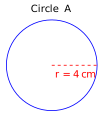
Question: What is the approximate area of Circle A? Use \(\pi\approx 3.14\).
- A. \(12.56\) cm\(^2\)
- B. \(25.12\) cm\(^2\)
- C. \(100.48\) cm\(^2\)
- D. \(50.24\) cm\(^2\)
Why it works: Using \(A = \pi r^2 \approx 3.14 \times 4^2 = 3.14 \times 16 = 50.24\) cm\(^2\).
Answer: \(50.24\) cm\(^2\)
Visual Model 2
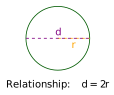
Question: If the radius of a circle is \(9\) inches, what is the diameter?
- A. \(4.5\) inches
- B. \(9\) inches
- C. \(18\) inches
- D. \(81\) inches
Why it works: The diameter is twice the radius. \(d = 2r = 2 \times 9 = 18\) inches.
Answer: \(18\) inches
Worked Examples
Example 1
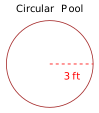
Question: A circular pool has a radius of \(3\) feet. What is the approximate area using \(\pi \approx 3.14\)?
- A. \(9.42\) ft\(^2\)
- B. \(18.84\) ft\(^2\)
- C. \(28.26\) ft\(^2\)
- D. \(56.52\) ft\(^2\)
- Area \(= \pi r^2 \approx 3.14 \times 3^2 = 3.14 \times 9 = 28.26\) ft\(^2\).
Answer: \(28.26\) ft\(^2\)
Example 2
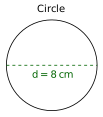
Question: The circle above has a diameter of \(8\) cm. Which expression finds its area?
- A. \(\pi \times 8\)
- B. \(\pi \times 8^2\)
- C. \(\pi \times 4^2\)
- D. \(2 \times \pi \times 4\)
- Diameter is 8 cm, so radius is 4 cm.
- Area \(= \pi r^2 = \pi \times 4^2\).
- (Choice D is circumference.)
Answer: \(\pi \times 4^2\)
Example 3
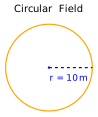
Question: A circular field has a radius of \(10\) meters. Using \(\pi \approx 3.14\), what is the area?
- A. \(31.4\) m\(^2\)
- B. \(62.8\) m\(^2\)
- C. \(314\) m\(^2\)
- D. \(628\) m\(^2\)
- Area \(= \pi r^2 \approx 3.14 \times 10^2 = 3.14 \times 100 = 314\) m\(^2\).
Answer: \(314\) m\(^2\)
Real-World Word Problems
Problem 1
Question: A circle has a diameter of \(12\) inches. What is the radius?
- A. \(3\) inches
- B. \(6\) inches
- C. \(12\) inches
- D. \(24\) inches
Why it works: The radius is half the diameter. \(r = \frac{d}{2} = \frac{12}{2} = 6\) inches.
Answer: \(6\) inches
Problem 2
Question: A circular pizza has a diameter of \(14\) inches. Which expression correctly represents its area?
- A. \(\pi \times 14^2\)
- B. \(2 \times \pi \times 14\)
- C. \(\pi \times 7\)
- D. \(\pi \times 7^2\)
Why it works: The diameter is 14 inches, so the radius is \(r = 7\) inches. Area \(= \pi r^2 = \pi \times 7^2\).
Answer: \(\pi \times 7^2\)
Common Mistakes
- Counting only the outside squares instead of all squares inside the figure.
- Leaving gaps or overlaps when using unit squares.
- Multiplying side lengths before checking whether the figure is a rectangle.
- Forgetting to write square units with an area answer.
Strategy Tips
- Trace the rectangle or figure before counting.
- Use rows and columns to organize unit squares.
- Write an equation after the model makes sense.
- Check whether the answer needs square units.
Practice Questions
Question 1
A circle has a radius of \(5\) cm. What is its approximate area? Use \(\pi\approx3.14\).
- A. \(15.7\) cm\(^2\)
- B. \(31.4\) cm\(^2\)
- C. \(78.5\) cm\(^2\)
- D. \(314\) cm\(^2\)
Question 2
A circle has a radius of \(8\) meters. What is the approximate area using \(\pi \approx \frac{22}{7}\)?
- A. \(176\) m\(^2\)
- B. \(201\) m\(^2\)
- C. \(352\) m\(^2\)
- D. \(1408\) m\(^2\)
Question 3
A circular garden has a radius of \(6\) feet. What is the approximate area using \(\pi \approx 3.14\)?
- A. \(18.84\) ft\(^2\)
- B. \(37.68\) ft\(^2\)
- C. \(113.04\) ft\(^2\)
- D. \(226.08\) ft\(^2\)
Question 4
A circle has an approximate area of \(78.5\) cm\(^2\). If \(\pi \approx 3.14\), what is the radius?
- A. \(5\) cm
- B. \(10\) cm
- C. \(12.5\) cm
- D. \(25\) cm
Question 5
Which statement is true about the radius and diameter of a circle?
- A. Radius is the distance across the circle
- B. Diameter is twice the radius
- C. Radius equals the diameter
- D. Diameter is half the radius
Question 6
A circle has a diameter of \(20\) cm. What is its approximate area using \(\pi \approx 3.14\)?
- A. \(62.8\) cm\(^2\)
- B. \(125.6\) cm\(^2\)
- C. \(314\) cm\(^2\)
- D. \(1256\) cm\(^2\)
Full Answer Explanations Click to show all answers and explanations
Question 1
Answer: \(78.5\) cm\(^2\)
Area of a circle \(=\pi r^2\approx3.14\times5^2=3.14\times25=78.5\) cm\(^2\).
Question 2
Answer: \(201\frac{1}{7}\) m\(^2\) or approximately \(201\) m\(^2\)
Area \(= \pi r^2 \approx \frac{22}{7} \times 8^2 = \frac{22}{7} \times 64 = \frac{1408}{7} = 201\frac{1}{7} \approx 201\) m\(^2\).
Question 3
Answer: \(113.04\) ft\(^2\)
Area \(= \pi r^2 \approx 3.14 \times 6^2 = 3.14 \times 36 = 113.04\) ft\(^2\).
Question 4
Answer: \(5\) cm
From \(A = \pi r^2\), we get \(78.5 \approx 3.14 \times r^2\), so \(r^2 \approx 25\), thus \(r = 5\) cm.
Question 5
Answer: Diameter is twice the radius
The diameter passes through the center and is \(d = 2r\). Choices A and C are incorrect; choice D reverses the relationship.
Question 6
Answer: \(314\) cm\(^2\)
Radius \(r = \frac{20}{2} = 10\) cm. Area \(= \pi r^2 \approx 3.14 \times 10^2 = 3.14 \times 100 = 314\) cm\(^2\).
Connection to Standards
This lesson supports Grade 6 math expectations for reasoning, modeling, problem solving, and explaining answers clearly. It connects classroom skills to the kind of questions students see on state math assessments.
Summary
Area of Circles Introduction becomes easier when students connect the question to a model, use clear steps, and explain why the answer fits.
GOLDEN RULE
Area means every square unit inside the figure.