With algebra, a system of equations equals 2 or more equations and desires a common solution for these equations. "A system of linear equations equals a set of equations satisfied via the same set of variables." Read More
A common technique used to solve equations, isolating a variable, additionally applies to answering inequalities. Via adding, subtracting, multiplying, and/or dividing, it’s possible to rewrite the inequality so the variable is on one side and all else is on the other. Like with one-step inequalities, the answers to multi-step inequalities may be graphed on a number line. Read More
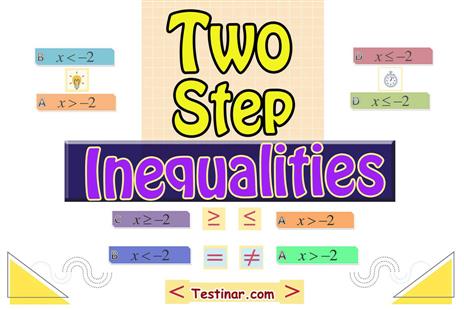
Two Step Inequalities are inequalities requiring two steps to solve. That means one must add, subtract, multiply, or divide twice to find the answer for the inequality. Whenever one solves each Two Step Inequality they’ll need to either subtract or add first and after that divide or multiply second to find the answer to the inequality. Read More
Quadratic equations are termed as those equations where the highest power or degree of the equation is \(2\). The standard form for a quadratic equation is \(ax^2 + bx + c = 0\), where \(a ≠ 0\). Now, let’s learn to solve quadratic equations by taking the example of equation \((x – 5)(x + 3)\).
First, let’s apply the distributive law to simplify the equations as \((x – 5)(x) + (x – 5)(3)\) ...
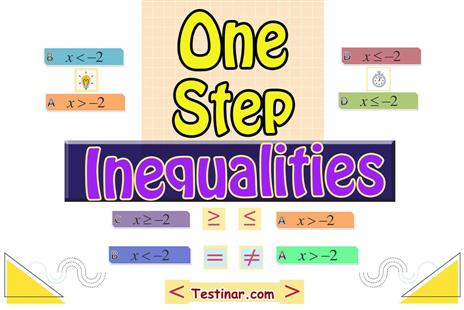
Solving single-step inequalities is a clear-cut process just like it sounds. There is merely a single step needed for completely solving these equations. The chief objective of solving a one-step inequality is to first isolate a variable on one side of the inequality symbol and then make its coefficient equal to one. The tactic for isolating a variable involves using opposite operations. For example, to move a number you subtracted from the other side of the inequality, you must add. Read More
Generally, a system of equations is defined by 2 equations that contain the exact same variables. When we solve this system of equations, we get the point of intersection of these 2 lines (each linear equation is actually an equation of a line). Now, we can solve a system of equations by 4 methods ... Read More
– Isolate the variable. – Find the value of the inequality on the number line. – For less than or greater than draw an open circle on the value of the variable. – If there is an equal sign too, then use filled circle. – Draw a line to the right direction. Read More