




Grade 5 Oregon Common Core Math Standards
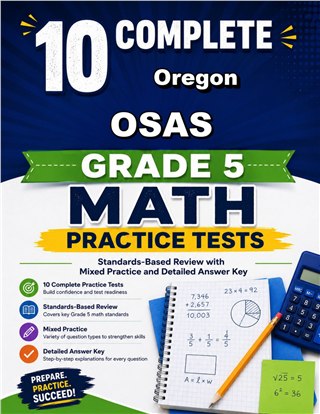
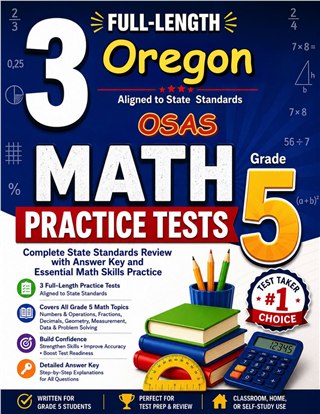
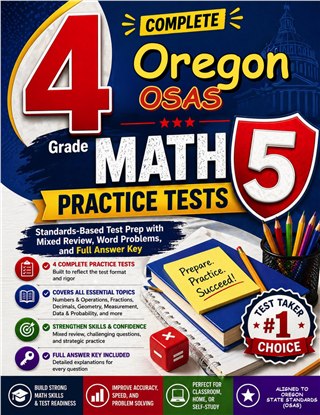
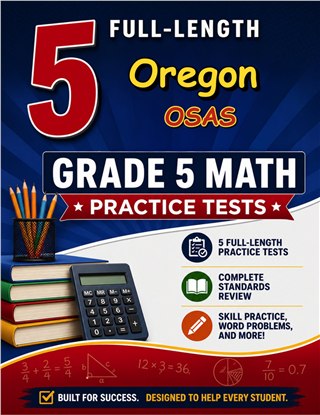
Use this guide to understand how the Grade 5 Oregon math standards fit together, why they matter for fifth-grade growth, and how they connect to OSAS readiness. Each standards section includes a plain-language explanation and links to detailed lessons students can practice right away.
Best Way to Use This Page
Start with the standards overview, then open the detailed lessons for any skill that feels weak. After students review the lessons, use the two full-length online quizzes to build stamina, pacing, and confidence.
Oregon Grade 5 Practice Quizzes
These quizzes use the custom quiz system and give students a timed online practice experience with 40 questions and 120 minutes.
Grade 5 Oregon Math Standards Organized Clearly
The Grade 5 standards are organized below by standard code. Each card briefly explains the standard and links to Testinar lessons that practice the connected skill.
Line Plots with Fractional Data and Solving Problems Using Line Plots
Generate questions to investigate situations within the classroom, school or community. Determine strategies for collecting or considering data involving operations with fractions for this grade that can naturally answer questions by using information presented in line plots
Stem-and-Leaf Plots
Analyze graphical representations and describe the distribution of the numerical data through line plots or categorical data through bar graphs. Interpret information presented to answer investigative questions
Understanding the Coordinate Plane
Graph and name coordinate points in the first quadrant using the standard (x, y) notation. Understand the coordinate points values represent the distance traveled along the horizontalx-axis and verticaly-axis
Graphing and Interpreting Points and Solving Problems on the Coordinate Plane
Represent authentic contexts and mathematical problems by graphing points in the first quadrant of the coordinate plane. Interpret the meaning of the coordinate values based on the context of a given situation
Properties of Two-Dimensional Figures and related Grade 5 skills
Classify two-dimensional figures within a hierarchy based on their geometrical properties, and explain the relationship across and within different categories of these figures
Converting Measurement Units and related Grade 5 skills
Convert between different-sized standard measurement units within a given measurement system. Use these conversions in solving multi-step problems in authentic contexts
Understanding Volume and Volume of Composite Figures
Recognize that volume is a measurable attribute of solid figures
Measuring Volume with Unit Cubes and related Grade 5 skills
Measure the volume of a rectangular prism by counting unit cubes using standard and nonstandard units
Solving Real-World Problems with Decimals and Solving Real-World Volume Problems
Relate volume of rectangular prisms to the operations of multiplication and addition. Solve problems in authentic contexts involving volume using a variety of strategies
Understanding Place Value and Introduction to Variables and Equations
Recognize that in a multi-digit number, a digit in one place represents 10 times as much as it represents in the place to its right and1/10of what it represents in the place to its left
Patterns with Powers of Ten and related Grade 5 skills
Use whole number exponents to denote powers of 10 and explain the patterns in placement of digits that occur when multiplying and/or dividing whole numbers and decimals by powers of 10
Reading and Writing Decimals to Thousandths and Comparing and Ordering Decimals
Read, write, and compare decimals to thousandths
Rounding Decimals
Use place value understanding to round decimals to any place
Multiplying Multi-Digit Whole Numbers and Multiplying Decimals
Fluently multiply multi-digit whole numbers using accurate, efficient, and flexible strategies and algorithms based on place value and properties of operations
Dividing with Two-Digit Divisors and related Grade 5 skills
Use a variety of representations and strategies to find whole-number quotients of whole numbers with up to four-digit dividends and two-digit divisors
Adding and Subtracting Decimals and Introduction to Probability
Use a variety of representations and strategies to add, subtract, multiply, and divide decimals to hundredths. Relate the strategy to a written method and explain the reasoning used
Adding Fractions with Unlike Denominators and related Grade 5 skills
Add and subtract fractions with unlike denominators, including common fractions larger than one and mixed numbers
Finding Common Denominators and related Grade 5 skills
Solve problems in authentic contexts involving addition and subtraction of fractions with unlike denominators, including common fractions larger than one and mixed numbers
Fractions as Division
Interpret a fraction as division of the numerator by the denominator (a/b=a÷b). Solve problems in authentic contexts involving division of whole numbers that result in answers that are common fractions or mixed numbers
Multiplying Fractions by Whole Numbers and Area with Fractional Side Lengths
Apply and extend previous understanding and strategies of multiplication to multiply a fraction or whole number by a fraction. Multiply fractional side lengths to find areas of rectangles, and represent fractional products as rectangular areas
Multiplication as Scaling
Apply and extend previous understandings of multiplication and division to represent and calculate multiplication and division of fractions. Interpret multiplication as scaling (resizing) by comparing the size of products of two factors
Multiplying Fractions by Fractions and Solving Real-World Problems with Fraction Multiplication
Solve problems in authentic contexts involving multiplication of common fractions and mixed numbers
Solving Multi-Step Word Problems with Whole Numbers and related Grade 5 skills
Apply and extend previous understandings of division to divide unit fractions by whole numbers and whole numbers by unit fractions, including solving problems in authentic contexts
Evaluating Expressions with Grouping Symbols
Write and evaluate numerical expressions that include parentheses
Writing and Interpreting Numerical Expressions
Write expressions that record calculations with numbers, and interpret numerical expressions without evaluating them
Generating Number Patterns and Analyzing Relationships Between Patterns
Generate two numerical patterns using two given rules. Identify and analyze relationships between corresponding terms. Form ordered pairs consisting of corresponding terms from the two patterns and graph them on a coordinate plane
OSAS Readiness Strategy
For best results, practice in short cycles: review one standards cluster, complete the linked lessons, solve mixed problems, then take a timed quiz. This helps students move from remembering procedures to choosing the right strategy in test-style problems.
Source note: This page is a plain-language study guide based on Testinar's local Grade 5 standards alignment data for Oregon Common Core and the Testinar Grade 5 lesson library. Always confirm current official state documents for district policy or legal decisions.