




The Virginia SOL Grade 5 Math test is a major checkpoint for whether students can use fifth-grade math skills clearly, accurately, and independently. Students need strong number sense, careful reading, organized scratch work, and enough practice to stay calm when a question looks unfamiliar.
This guide is written for parents, teachers, tutors, and students who want a complete preparation plan. You will learn what to review, which Grade 5 math skills matter most, how to build a 4-week SOL study plan, what mistakes to watch for, how to use practice tests, and how to help students feel ready without cramming.
What Is the SOL Grade 5 Math Test?
The SOL Grade 5 Math test measures how well students can apply the math expectations taught in Virginia classrooms. It is not only about remembering facts. Students must read problems carefully, choose useful strategies, work with models and numbers, and explain their thinking through accurate reasoning.
The test may include straightforward computation, multi-step word problems, data interpretation, measurement, geometry, and questions that require students to connect several skills. That means preparation should include more than repeated worksheets. Students need to practice reading test-style questions, organizing work, checking answer choices, and explaining why an answer makes sense.
Because assessment platforms and policies can change, parents should confirm the official test window, calculator or tool rules, and format details with the school or state assessment office. The study plan below focuses on the Grade 5 math skills that students need regardless of small format changes.
Virginia SOL Grade 5 Math Skills Covered
A strong SOL preparation plan focuses on the skills students are most likely to use across many questions. Grade 5 math connects whole-number operations, decimals, fractions, geometry, measurement, data, and word problems. Students should not study these topics as isolated tricks. They should learn how the skills appear inside multi-step problems.
Fractions
Fractions are one of the biggest confidence builders for Grade 5 math. Students should compare fractions, find common denominators, add and subtract fractions with unlike denominators, multiply fractions, divide unit fractions by whole numbers, and solve fraction word problems.
Decimals and Place Value
Students need to read, compare, round, add, subtract, multiply, and divide decimals. Decimal place-value errors are common because a small shift in the decimal point changes the entire answer. Students should practice with money, measurement, and estimation.
Whole-Number Operations and Numerical Expressions
SOL questions often require multiplication, division, estimation, and order of operations inside word problems. Students should know when to multiply, when to divide, and how to write an expression that matches the situation.
Volume, Measurement, and Geometry
Grade 5 students should understand volume as the amount of space inside a rectangular prism. They should know how to count unit cubes and use formulas such as length times width times height. They should also recognize geometric attributes such as angles, sides, parallel lines, and quadrilaterals.
Coordinate Planes, Graphing, and Data
Students should understand ordered pairs, coordinate grids, line plots, tables, and data displays. They need to read graphs carefully and connect points or data values to real-world meaning.
Word Problems and Reasoning
Word problems are where many students lose points even when they know the math. The key is to slow down, underline what the question asks, choose the operation, solve neatly, and check whether the answer makes sense.
Best 4-Week SOL Study Plan
A good study plan should feel steady, not overwhelming. Four weeks is enough time to review key skills, find weak areas, and build test stamina if students work consistently. The goal is not to do every worksheet available. The goal is to practice the right skills, review mistakes, and improve a little each week.
Week 1: Fractions and Decimals
- Review equivalent fractions, common denominators, and fraction operations.
- Practice decimal place value, rounding, addition, subtraction, multiplication, and division.
- Use visual models first, then move to standard procedures.
- End the week with 15 to 20 mixed fraction and decimal questions.
Week 2: Whole Numbers, Expressions, Volume, and Geometry
- Practice multi-digit multiplication and division.
- Review expressions with parentheses, brackets, and order of operations.
- Study volume with cubes and formulas.
- Review geometric attributes such as angles, sides, parallel lines, and quadrilaterals.
Week 3: Graphing, Data, Measurement, and Word Problems
- Practice coordinate-plane questions with ordered pairs.
- Read line plots, tables, and graphs.
- Review measurement conversions and units.
- Use multi-step word problems every day and require students to explain their plan before solving.
Week 4: Timed Practice and Error Review
- Take one full-length or near full-length practice test early in the week.
- Create an error log with the topic, mistake type, and corrected solution.
- Retake similar questions for every missed skill.
- Take a second timed practice set near the end of the week to measure improvement.
A Simple Daily Practice Routine
The best daily SOL practice routine is short, focused, and repeatable. A student does not need two hours every night. In many cases, 25 to 35 minutes of honest practice is better than a long session filled with frustration.
- Warm up for 5 minutes. Review multiplication facts, decimal place value, or fraction equivalents.
- Study one skill for 10 minutes. Use a worked example and have the student explain each step.
- Practice 6 to 10 questions for 15 minutes. Mix straightforward questions with word problems.
- Review mistakes for 5 minutes. Ask what went wrong and how to avoid it next time.
Common SOL Grade 5 Math Mistakes
Many test mistakes are not caused by a lack of effort. They come from habits students can fix with practice. Watch for these patterns during review.
- Rushing word problems: Students solve before identifying what the question is asking.
- Forgetting units: A volume problem may need cubic units, while a length problem needs linear units.
- Decimal place errors: Students line up digits incorrectly or place the decimal in the wrong location.
- Fraction simplification mistakes: Students may stop too early or simplify only the numerator.
- Choosing the first answer that looks reasonable: Test answer choices often include common mistake answers.
- Weak scratch work: Messy work makes it harder to catch errors.
- Not checking reasonableness: Estimation can quickly reveal an impossible answer.
SOL Grade 5 Math Practice Questions
These original Testinar questions are written in a state-test review style. Have students solve first, then read the explanation. The explanation matters because readiness depends on reasoning, not memorizing answer letters.
Question 1: Fractions
Mia has \(\frac{3}{4}\) yard of ribbon. She uses \(\frac{1}{6}\) yard for a project. How much ribbon does she have left?
Answer: \(\frac{7}{12}\) yard.
Explanation: Use a common denominator of 12. \(\frac{3}{4}=\frac{9}{12}\) and \(\frac{1}{6}=\frac{2}{12}\). Then subtract: \(\frac{9}{12}-\frac{2}{12}=\frac{7}{12}\).
Question 2: Decimals
A notebook costs $4.25. A student buys 1.6 times that amount in supplies. What is \(4.25 \times 1.6\)?
Answer: 6.8.
Explanation: Multiply 425 by 16 to get 6800. Since the original factors have three decimal places total, place the decimal three places from the right: 6.800, or 6.8.
Question 3: Volume
A rectangular prism is 8 inches long, 5 inches wide, and 4 inches tall. What is its volume?
Answer: 160 cubic inches.
Explanation: Volume equals length times width times height. \(8 \times 5 \times 4 = 160\). Because volume measures space inside a solid figure, the unit is cubic inches.
Question 4: Coordinate Plane
A point is located at \((3, 4)\). It moves 2 units right and 5 units up. What are the new coordinates?
Answer: \((5, 9)\).
Explanation: Moving right increases the x-coordinate, so \(3 + 2 = 5\). Moving up increases the y-coordinate, so \(4 + 5 = 9\).
Question 5: Multi-Step Word Problem
A teacher has 6 boxes of pencils. Each box has 24 pencils. She gives 38 pencils to students. How many pencils are left?
Answer: 106 pencils.
Explanation: First find the total number of pencils: \(6 \times 24 = 144\). Then subtract the pencils given away: \(144 - 38 = 106\).
Question 6: Data and Reasoning
A student reads 18 pages on Monday, 22 pages on Tuesday, 25 pages on Wednesday, and 15 pages on Thursday. What is the average number of pages read per day?
Answer: 20 pages.
Explanation: Add the pages: \(18 + 22 + 25 + 15 = 80\). Divide by 4 days: \(80 \div 4 = 20\).
How to Improve SOL Math Scores
The fastest way to improve is to stop treating every missed question the same. A student who misses a fraction problem because of a common denominator mistake needs a different fix than a student who missed it because the word problem was misread. Use an error log with three columns: skill, mistake, and correction.
Strong score improvement usually comes from timed practice, error analysis, targeted reteaching, and mixed review. Practice tests should be used as checkpoints, not just as one-time score reports.
SOL Math Test-Day Strategies
Test-day success starts before the first question. Students should sleep well, eat breakfast, arrive prepared, and know that one hard question does not decide the entire test. Confidence matters because anxious students often rush or abandon strategies they know.
- Read each problem twice before solving.
- Circle or note exactly what the question asks.
- Use scratch work for multi-step problems.
- Estimate before choosing an answer when possible.
- Check units, especially for measurement and volume.
- Use remaining time to check flagged questions, not to change answers randomly.
Practice Resources and Virginia SOL Workbooks
For official rules, testing windows, score reporting, accommodations, and calculator guidance, families should always check the school, district, or state assessment office. For skill review, use focused lessons before taking full practice tests.
- Grade 5 Virginia Math Standards
- Adding Fractions with Unlike Denominators
- Dividing Unit Fractions by Whole Numbers
- Adding and Subtracting Decimals
- Understanding Volume
- Finding Volume Using Formulas
- Properties of Two-Dimensional Figures
- Understanding the Coordinate Plane
- Graphing and Interpreting Points
Timed practice tests
Virginia SOL Grade 5 Math Practice Tests
Use these two online practice tests after the lesson review. They open in a new tab so students can practice without losing this study guide.
Need realistic SOL Grade 5 Math practice?
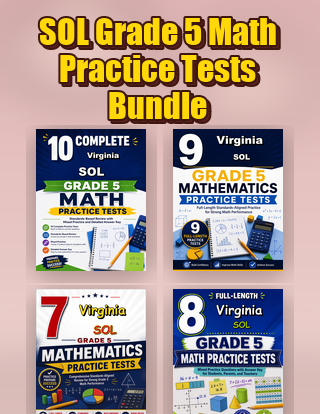
Explore full-length Virginia SOL Grade 5 Math practice tests with printable PDF format, answer support, and standards-aligned review. Use them as weekly checkpoints, full review tests, or a final readiness routine before test day.
View 10 Virginia SOL Grade 5 Math Practice Tests View The Virginia SOL Grade 5 Math Practice Tests Bundle
FAQ: Virginia SOL Grade 5 Math Preparation
Is the Virginia SOL Grade 5 Math test difficult?
It can feel challenging when students are not used to multi-step problems, mixed skills, and test-style wording. A steady plan that reviews fractions, decimals, volume, geometry, data, and word problems makes the SOL much more manageable.
What should students study first for Virginia SOL Grade 5 Math?
Start with fractions, decimals, multiplication, division, and multi-step word problems. These skills support many other Grade 5 topics and help students build confidence quickly.
How long should students prepare for the SOL Grade 5 Math test?
Four focused weeks is a strong starting point. Students should review skills, practice mixed questions, analyze mistakes, and take at least one timed practice test before test day.
Are calculators allowed on the Virginia Grade 5 math assessment?
Calculator and tool rules can vary by state, year, and student accommodation. Families should confirm the current SOL rules with the school, district, or official state assessment guidance before test day.
How can students improve their SOL math score quickly?
Use an error log. After each practice set, write the missed skill, the mistake, and the corrected solution. Then practice similar problems before moving to a new topic.
Is the SOL Grade 5 Math test aligned to state standards?
Yes. Grade 5 state math assessments are designed around the state's math standards. For this guide, connect the study plan to Virginia Standards of Learning and use standards-aligned practice questions.
What is the best way to use Virginia Grade 5 Math practice tests?
Use practice tests as checkpoints. Take one test to find weak areas, study those weak skills, review mistakes carefully, and then take another test to measure improvement.
Summary
Preparing for Virginia SOL Grade 5 Math is not about panic or last-minute memorization. The best plan is steady: review the tested skills, practice test-style word problems, use mixed review, analyze mistakes, and build stamina with realistic practice tests. When students understand both the math and the test format, they can approach the exam with confidence.